
Potted Hoya Heuschkeliana houseplant
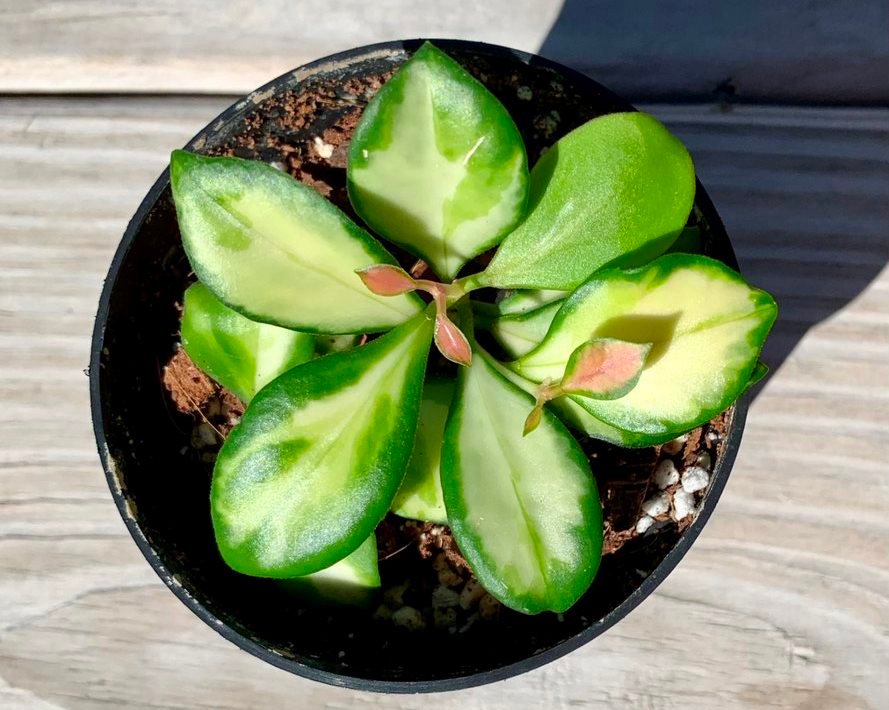
Are you really after the hoya collection hype? If so, this is one of those sensational variegated kinds of plants. There is every bit in this houseplant’s physical appearance and uniqueness.
At a glance, this variegated houseplant may be confused with hoya Krimson princess.
Knowing a Hoya Heuschkeliana Variegata
This hoya is a flowering climber that belongs to the Apocynaceae family. Its fame is gradually growing for its attractive foliage and waxy flowers. The leaf blades bear sparky white variegation from the mid veins, spreading out beautifully. The edges are green.
Heuschkeliana variegata bears spectacular tiny blooms. This climber produces these flowers in clusters. Every single flower comprises a star-shaped umbel. Each umbel makes up to 12 flowers. They are pale pink to dark pink. These flowers are fantastically appealing too.
Each flower is bell-shaped. With a strong fragrance during the day. They last up to 7 days.
If you have this one on your houseplant list, the flowers will appear from late spring to late summer.
They make excellent hanging baskets since they do vine out of baskets slowly and more gradually.
Caring for your Hauschkeliana Variegata
To enable the plant to reach its full potential, provision of care requires that you have crucial details about your area. These include the location, time of the year, and current localities.
1. Watering Needs
Your houseplant may not require much or excess water. In fact, you need to water on individual needs.
If you live in a warm climate, the houseplant needs 0.8 cups of water every 10 – 14 days. Add 0.1 cups of water if you subject the houseplant to direct sunlight.
2. Light Lumens for your Houseplant
Due to variegation, this beauty can be stressed in poorly light indoor rooms. Whenever there is not ample light, growth may be thwarted.
If you live in a tropical location, finding ideal lighting should not be difficult. Go for the south-facing windows. Ensure you place your variegated plant a few inches away from the window sills.
3. Fertilizing and Feeding Needs
The essential element constitution of the potting soil is a key guiding factor to how you feed this houseplant. These elements are Nitrogen, Potassium and Phosphorus.
Feed your houseplant according to its size and season. During the initial stages of growth, you do not need to emphasize applying fertilizers. If the potting soil came with ample nutrients, feed less frequently. Your plan can still produce foliage even with neglect.
However, for foliar development in the latter stages, regular fertilizing is key. Use a liquid fertilizer twice a month.
A fertilizer with a high phosphorus content is very crucial around the blooming time. To promote robust growth, use a fish emulsion feed once or twice a month.
4. Replanting (Transplanting)
Being an epiphyte means the plant does not have an established root system. In fact, the roots only act as a support base. As such, variegated heuschkeliana doesn’t need regular repotting.
5. Rooting Medium Qualities
A well-draining soil type, but less chunky is ideal for the growth of the plant’s epiphytic roots.
Key components/ingredients that make up the soil for this one should include the following:
- Medium-high organic matter
- Perlite
- Coco coir
6. Propagation and How-to’s
I discourage planters from repotting carnosa varieties. The majority, if not all the varieties, love being root-bound. Most gardeners who love these potted unique plants can repot in the third year.
Planning to replant your carnosa? The most convenient time to repot is early springtime. However, don’t wait until the end of summer.
Prepare a matter-rich houseplant mix. Or just blend out of the following:
- 2 parts organic potting soil
- compost
- worm castings
- orchid grow mix – comprising fine fir bark & perlite
Even in their third year, you have to excuses for excuses why you need to replant/repot. You can courageously do so based on the following indications:
- watering your carnosa variety very often than not
- pot medium drying out quickly
- roots have peeped out of the drainage holes
- plant width seems to have outgrown the size of its pot
Then carry out these step-by-step:
- Gently remove the whole plant from its current vessel
- Loosen the root ball
- If it is really root-bound, make a few vertical cuts
- Select 1 – 2 inches (in diameter) larger pots with drainage holes
- Go for new terracotta pots (or your preferred ones)
- Use the above propagating soil/mix formula
Many Hoya carnosa varieties do best in bright light. A few can tolerate direct sunlight a little bit.
For some types of hoya carnosa to bloom or just flower, a little direct light could make the difference.
Indoors, a south or west-facing window is ideal for varieties with less solid green foliage. Variegated Hoyas like the H. carnosa ‘Krimson Princess’ or ‘Krimson Queen’ need more light, but solid green varieties can tolerate moderate to low light.
Any variety with solid green foliage is suitable for an east-facing window. If you live in the tropics, situate this one a few inches from the windowsill.
Outdoors, nearly all hoyas will love bright spots with dappled shade. If you love those hanging vines, such outdoor rooms are the best.
7. Care Against Winter Frost
These houseplant does not phase in wintertime. Growth only slows down.
However, they have one major weakness in the winter. If you overwater they will disappoint. As such, you need to pay attention to watering.
Other crucial wither care details are as follows:
- stop fertilizing until spring
- Maintain or elevate humidity levels if you detect a drop
- Keep your houseplant away from the heat vents and other sources of heat
Growth Issues and Fixes for Hoya Heuschkeliana Variegata
The two common issues that may negatively impact the growth of your houseplant are pests and disease.
Pests
The plant itself is not a pest inviter unless you expose it. Common problematic pests to this one are majorly the sap suckers. They include aphids, scale, mealybugs and mites.
If you want to enjoy every bit of greatness that this plant offers, you out to keep pests at bay. To easily manage them, begin with pest control and preventive measures. For soft-bodied pests, apply horticultural oils. Dilute them for optimal use.
For preventive measures, ensure you have fixed the following issues.
- Keep an eye on the vines and leaf nodes regularly for pests
- Check to see whether your houseplant has mold growths
- Also, inspect the underside of leaves for
Diseases
To investigate cases of disease invasion, be keen to read the following signs.
- Dark spots on the foliage accompanied by light patches on the leaves
- Growths of mold-like structures on the vines
Addressing fungal issues is possible. Keep your houseplant in rooms with specially-regulated humidity levels. If you are a beginner, work with humidity devices to help maintain these levels at 64 – 70 percent.
Do not mist the spouting parts, flower buds or the flowers.
Additionally, regulate household temperature so that it falls within 65 – 80 Fahrenheit most of the day and night time.
References & Sources
- Hoya heuschkeliana. Plants of the World Online. https://powo.science.kew.org/taxon/urn:lsid:ipni.org:names:937612-1. Accessed online 28 Jan 2023
- Hoya Heuschkeliana. NATIONAL PARKS. https://www.nparks.gov.sg/florafaunaweb/flora/5/3/5379. Accessed online 28 Jan 2023


